

- Home
- Sixth Form
- 16-19 Programme of Study
16-19 Programme of Study
16–19 Programme of Study at Clarendon Sixth Form
At Clarendon Academy, we are dedicated to providing a robust and comprehensive 16–19 study programme that prepares every student for success at Key Stage 5 and beyond. Our 2024–2026 action plan is closely aligned with our Key Performance Indicators (KPIs), ensuring that all decisions are guided by the needs of our most vulnerable learners and underpinned by our values of care, excellence, and continuous improvement.
Our Sixth Form programme offers more than just academic study. It is a carefully designed framework that provides a well-rounded education, equipping students aged 16 to 19 with the skills, knowledge, and confidence needed for their next steps—whether that is further education, apprenticeships, or the world of work.
We achieve this by combining high academic standards with exceptional pastoral support, fostering an environment where students not only achieve their academic goals but also grow personally and socially. We are committed to supporting parents as partners in this journey and to ensuring that every student is fully prepared for a successful and fulfilling future.
Programme Aims, Structure & Pathways
Programme Aims, Structure & Pathways
Building on our commitment to academic excellence and holistic development, the Sixth Form programme is structured to ensure that each student receives a personalised, purposeful education experience. The programme is designed to provide:
- Recognised core academic, technical, or vocational qualifications aligned with students' goals.
- Meaningful work experience or employment preparation to develop practical, transferable skills.
- Support in English and Maths, where required, to secure essential qualifications (if GCSE grade 4/C or above has not been achieved).
- Enrichment opportunities that foster personal development, independence, and readiness for adult life.
Programme Structure & Pathways
Each student's study programme is built around their prior attainment, interests, and future aspirations. Key features include:
- A core qualification or employment-focused programme tailored to individual goals.
- Work experience in Year 12, aligned with the student’s chosen field or career path.
- Weekly tutorial sessions offering tailored guidance on academic progress, personal development, and next steps.
We use a Pathways Model to support students in selecting the most suitable study route. While the model offers clear guidance, we recognise that some students may benefit from a bespoke programme — and we are always willing to tailor options to meet individual needs.
Support is delivered through our Sixth Form team, in collaboration with our Head of Careers and partners such as the Wessex Inspiration Network (WIN).
Our Pathways
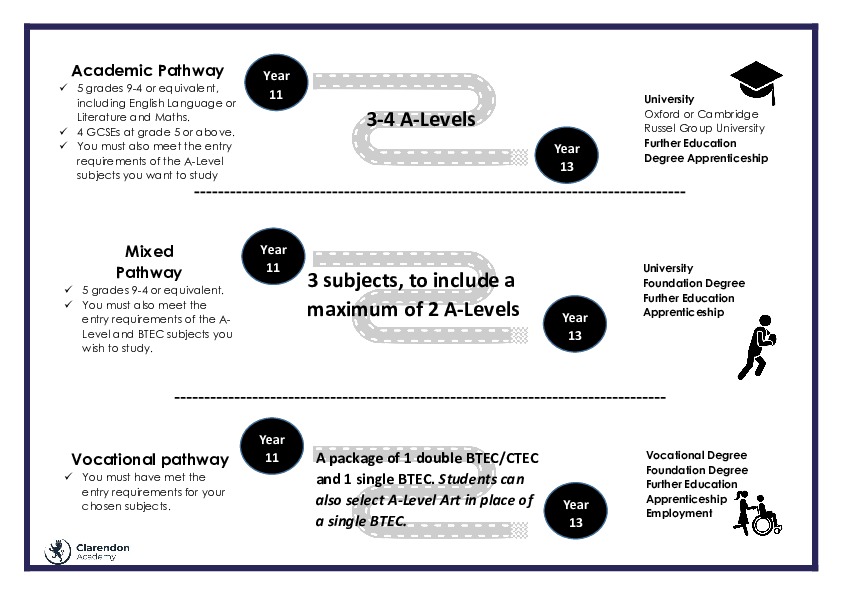
We offer a Pathways Model to guide students towards a study programme that we know they will succeed in. Please note, however, that the Pathways Model is only a guide for individual students: where a student wishes to study a bespoke combination of subjects or study programme, we always seek to accommodate them. There are three Pathways available, each of which involves its own entry criteria:
Academic Pathway
This study programme is suited to students who have achieved five or more GCSEs at grades 4 or above, including Maths and English. At least four of these GCSEs should be at grade 5 or higher.
Focus: A-Level subjects.
Best suited for: Students aiming for university or a degree-level apprenticeship.
Mixed Pathway
This study programme is suited to students who have achieved five or more GCSEs at grades 4 or above, including Maths and English.
Focus: A combination of A-Level and vocational qualifications (BTEC/CTEC)
Best suited for: Students planning to pursue a vocational degree, a higher-level apprenticeship, or a flexible career route such as an apprenticeship.
Vocational Pathway
For students who have demonstrated strong performance in vocational subjects at Key Stage 4 and want to continue these studies.
Focus: Full vocational programme (BTEC/CTEC)
Best suited for: Students moving towards a foundation degree, apprenticeship, or employment after Sixth Form
Each pathway offers clear progression opportunities and is designed to maximise individual success.
Subject-Based Entry Requirements
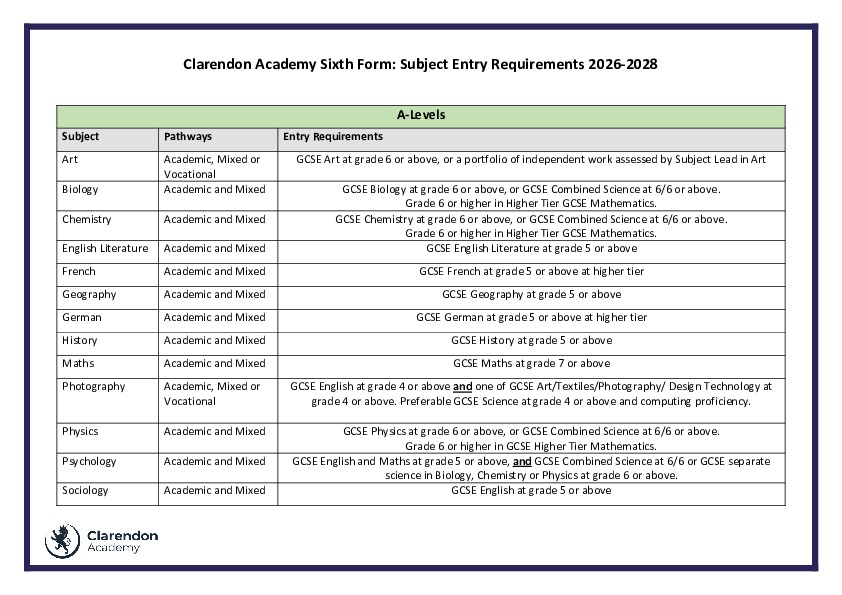
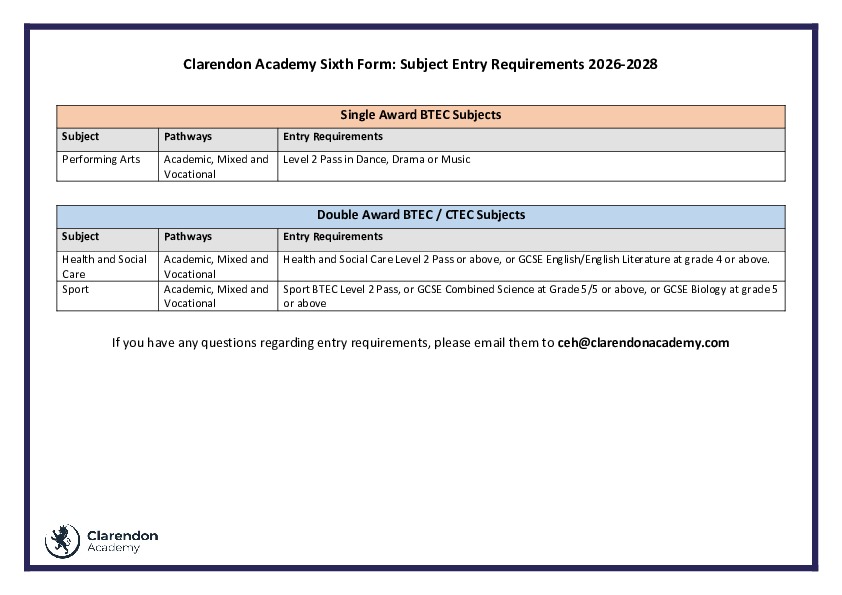
As well as meeting the entry criteria for their selected Pathway, students must meet the entry requirements for their individual chosen subject. We offer a selected range of subjects to prepare students for university, apprenticeships, or careers:
A-Level Subjects (Academic & Mixed Pathways):
Maths, English Literature, Biology, Chemistry, Physics, History, Geography, German, French, Psychology, Sociology, Art and Photography
Vocational Options (Mixed & Vocational Pathways):
BTEC Performing Arts, CTEC Sport, BTEC Health & Social Care
Entry Requirements are carefully set to ensure students are placed on a programme where they can succeed. We maintain rigorous entry requirements to ensure that students are well-prepared for the challenges of our study programme. We do not want to set any student up to fail, and therefore really stick to our entry requirements to ensure our students can succeed.
Subject essentials
To support independent learning at Sixth form, each subject provides Academic Calendars and Subject Essentials—key tools for student success.
Academic Calendars give a clear overview of the course across Years 12 and 13, showing:
- Topics and schedule – what is studied and when.
- Teacher responsibilities – who teaches each topic.
- Assessment points – assignments, tests, and exams.
Subject Essentials outline:
- Exam Board and specification – what is studied and assessed.
- Assessment structure – exam papers, practicals, objectives (AOs), and grading guidance.
- Support for all students – strategies for A*/A grades and help for those finding topics challenging.
- Future pathways – how the subject links to careers and further study.
- Teacher contacts – for guidance and support.
Together, these documents equip students to plan effectively, track progress, and achieve their best outcomes, while preparing them for success beyond school.
Study Hours
Study Hours
All Sixth Form programmes are full-time and meet the government’s requirement of at least 540 planned hours of learning per academic year. These include:
- Core subject lessons based on the student’s chosen pathway
- Tutorial and enrichment sessions
- Work experience or employability training
- Additional academic support where needed
The table below outlines the qualification- and non-qualification hours that are typical of each student in the Sixth Form: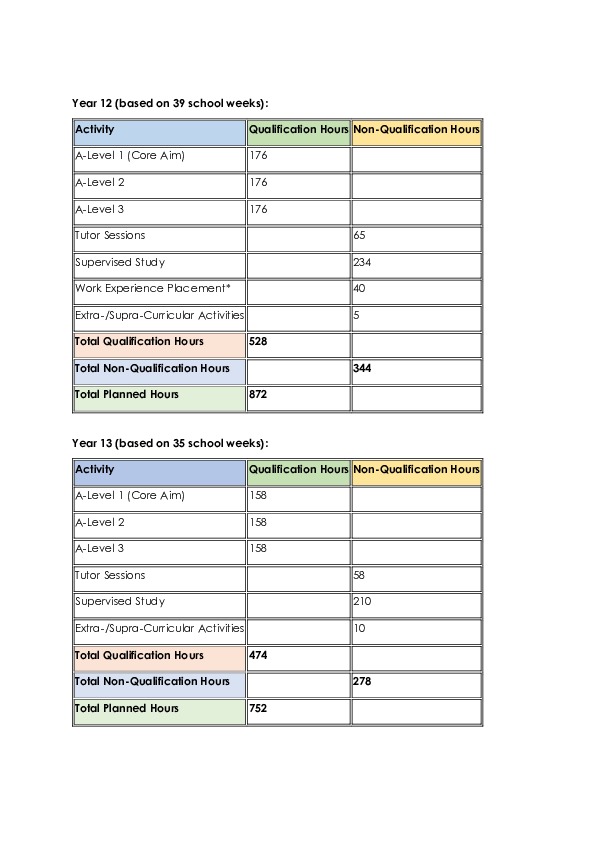
Assessment and Progression
Students are assessed in line with the requirements of their core qualifications through a combination of coursework, practical assignments and examinations. Progress is regularly monitored to ensure that each student is on track to achieve their target grades. Individual support, feedback, and guidance are provided to help students progress to the next stage of their education, training, or employment.
Supervised and Independent study
We believe that, alongside their timetabled lessons, students should be given space, in a structured and supervised environment to complete homework, read ahead, review notes and complete coursework assignments in order for them to meet deadlines. Students are encouraged to commit fully to their learning, aiming to spend at least one hour of independent study for every hour in the classroom. We accept that many of our students have part-time employment outside of school. This Supervised Study approach supports students in staying on top of their work while allowing flexibility for part-time jobs or other commitments outside school.
Attendance and Punctuality
Success in Sixth Form depends on reliability, self-discipline, and accountability. Students are expected to maintain 97%+ attendance, be punctual, and come prepared, habits that support academic achievement, personal growth, and future success. Attendance is monitored closely, with support or action taken as needed to ensure all students meet their potential.
Tutor Programme
The tutor programme is designed to equip students with the knowledge, skills and guidance they need to thrive as happy, healthy and confident individuals. It supports students in developing the resilience and self-awareness required to navigate the challenges of education, the workplace and personal life. The programme also forms the foundation for our statutory PSHE and careers education, ensuring that every student receives high-quality, age-appropriate learning in these key areas. This curriculum is delivered through a combination of timetabled tutor sessions, assemblies and guest speakers, and includes the following:
• Guidance on personal health and wellbeing: This provision is shaped by the guidelines published by the PSHE Association for post-16 students (see www.pshe-association.org.uk). It expands on the content delivered in the PSHE curriculum at Key Stage 4 and includes issues such as sexual health, illegal drugs, responsible online behaviour and mental health awareness. It includes the statutory Relationships and Sex Education material specified by the DfE at Key Stage 5.
• Careers and post-18 options: This includes information on employment trends at both regional and national levels, as well as advice and guidance on employability skills and professional behaviour. Our careers programme is fully aligned with the Gatsby Benchmarks, ensuring that students receive a comprehensive, high-quality careers education. This includes access to up-to-date labour market information, opportunities for encounters with employers and employees, experiences of workplaces, and guidance that links curriculum learning to future career pathways.
Students in Year 12 are supported in identifying and organising a work experience placement that reflects their future aspirations, in line with Gatsby Benchmark 6 (Experiences of Workplaces). All students receive tailored support in researching and applying for post-18 options, including higher education, apprenticeships, and employment, ensuring that they make informed and ambitious choices for their next steps.
• Study skills: All students are supported in understanding the process of learning, including how they acquire and retain knowledge, manage their time effectively, and set achievable goals. As part of the tutor programme, students are taught strategies to improve their independent study skills, such as note-taking techniques, revision methods, research and critical thinking skills, and how to evaluate their own progress. Tutors/teachers regularly guide students in reflecting on their learning, identifying areas for improvement, and developing personalised strategies to maximise their academic performance. This support helps students become self-directed learners who are confident and prepared for the demands of Sixth Form study and beyond.
Support, Curriculum & Performance Framework
Students will have access to a wide range of support and guidance throughout their programme to help them achieve both academically and personally. This includes:
• Careers advice and guidance
• Support for health and wellbeing
• Information and advice on financial support
• Supervised & Independent study sessions to encourage independent learning.
We are committed to ensuring every student has the guidance, structure, and resources needed to succeed. Our framework clearly defines how we support students across pastoral care, learning, and personal development, while tracking progress through key performance indicators (KPIs).
- Support Framework
Our support framework clearly defines areas of responsibility, ownership, support, and quality assurance to help our students thrive:
|
Area of Responsibility |
Ownership |
Support |
Quality Assurance |
|---|---|---|---|
|
Pastoral Care |
Sixth Form Team & Tutors |
Curriculum Leaders & Teachers |
Senior Leadership Team (SLT) |
|
Behaviour and Attitudes |
Sixth Form Team & Tutors |
Curriculum Leaders & Teachers |
SLT |
|
Attendance |
Sixth Form Team & Tutors |
Curriculum Leaders & Teachers |
SLT |
|
Curriculum |
Curriculum Leaders & Teachers |
- |
SLT |
|
Organisation |
Curriculum Leaders & Teachers |
Sixth Form Team & Tutors |
SLT |
|
Teaching & Learning Standards |
Curriculum Leaders & Teachers |
Sixth Form Team |
SLT |
- Curriculum Model
Our curriculum offers a diverse range of subjects, allowing every student to choose pathways that match their interests and career ambitions. It is flexible, accommodating joint classes and adjustments based on student feedback and enrolment numbers.
- Quality Assurance
We continuously monitor teaching and learning standards, student engagement, and pastoral support. Clear roles and responsibilities ensure that every part of our programme meets high expectations, enabling students to thrive academically and personally.
iv) Key Performance Indicators (KPIs)
Our Key Performance Indicators (KPIs) shape the way we plan, monitor, and improve our sixth form programme. By focusing on these benchmarks, we ensure that every decision we make supports the success and wellbeing of all students, particularly those who may need extra guidance.
- L3VA: 0
- Average Grade: B-
- ALPs: All subjects at ALPs 5 or better
- Attendance: 95% minimum for each student
- Number on each course: 8+
- Retention 11 into 12: 45% - 55%
- Retention 12 into 13: 95%
- Student, Staff, Parent Voice: 85% would recommend the school
- Quality Assurance Visits: Solidly good
This policy will be reviewed annually to ensure it remains current, reflects the latest guidance, and aligns with best practices.